April 15, 2026
by John Baich, SECC Chair & CBA ABIP Inspector
Sangre de Cristo Broadcast Consulting, LLC
Another issue I come across in my inspections is the lack of a functional remote transmitter control systems. The FCC’s 47 CFR § 73.1350 outlines the mandatory operational requirements for broadcast station transmission systems. The bottom line: you must operate by the rules and be able to verify (document) compliance thereof.
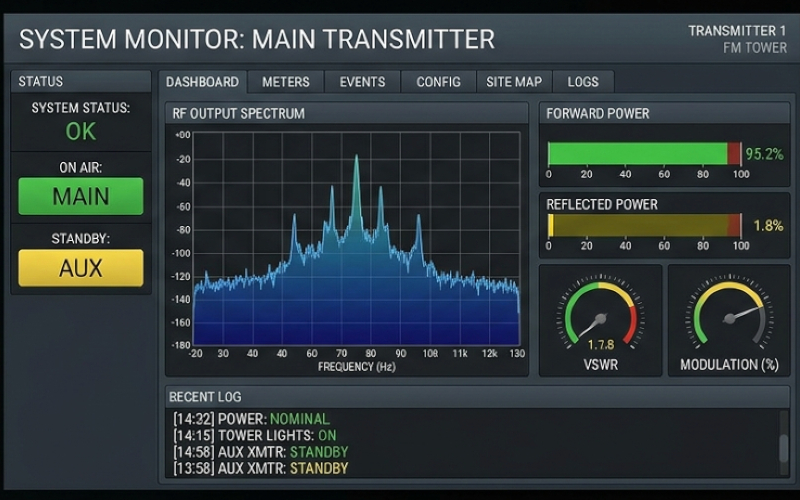
Today, many broadcasters use exception-based monitoring systems requiring no interaction unless there is a problem. A functional system will inform you, via email, text, or phone call alerting you to a problem or automatically respond to a problem when it occurs. Many transmitter manufactures have these functions baked in requiring minimal set up. Keep in mind that there are other critical items: tower lighting, antenna control, environmental controls, site security to name a few that need to be considered. Test and document that these systems are actually working on a regular basis.
Some stations have integrated full site remote control systems providing real-time logging and control via a central GUI. These systems can be programmed as complex as running automated overnight proofs or performing other maintenance tasks on your behalf then providing a report for your morning review. In my past life I even tied in the coffee maker so that I had a fresh pot awaiting me for that midnight call or scheduled overnight maintenance.
The rules require that you must immediately power down If your station is operating in a manner that poses a threat to life or property or that is likely to significantly disrupt the operation of other stations. In such cases, operation must be terminated within three minutes unless antenna input power is reduced sufficiently to eliminate any excess radiation. This would include: the emission of spurious signals that cause harmful interference, any mode of operation not specified by the station license for the pertinent time of day, or operation substantially at variance from the authorized radiation pattern, or a lessor informs you a tower worker is about to ascend the tower. Can you get to your site within three minutes, doubtful unless you’re sleeping on a cot next to the transmitter.
The three-hour requirement to cease or alter broadcast operation if excessive power, excessive modulation or the emission of spurious signals (that do not result in harmful interference) occurs. Again, I ask, can you get to that remote mountain site in January within three hours?
Twice in my career during a random pop FCC inspection (before the days of ABIP certifications) the inspector had asked my operator to turn off the transmitter. Both times resulted in a flushed faced shaky handed operator reaching for the remote control only to be stopped just before the off button was pushed. “I wanted to make sure you knew how to do it” responded each inspector. Can your operations staff pass this test?
Transmitter output power is going to be the first test, if you can’t pass this you’re already in trouble:
- AM stations not using MDCL (modulation dependent carrier level), 90% to105% of your authorized power
- FM Stations operating more than 10 Watts, 90% to 105% of your authorized power
- TV Stations 80% to110% of your authorized power.
Again, are you going to be able to verify you’ve met these requirements; are they logged?
Another thing I see in the field is the miss-understanding of what to do when not making your authorized power. Say you lose half of your PA, you diagnose the problem, tell your GM why your coverage is diminished, order parts, and get on with the rest of your day. Keep in mind you must inform the FCC if operating at reduced power will exceed 10 consecutive days. Notification must be made to the FCC in a Reduced Power Notification via LMS, not later than the 10th day. If things are really bad, you must apply and receive a STA (special temporary authorization) if your outage is going to exceed 30 days.
Finally, let’s talk Control Points; the locations where you can control your transmitter, where your license authorizations must exist, where the FCC shows up, essentially your broadcast facilities. Control points such as your transmitter and main studio must be authorized. Any change or addition of a Control Point, such as moving, a corporate hub location, sister station, etc. must be sent to the FCC withing three days of the use of that point. When I ask a chief where their control points are I am invariably shown their phone, tablet, or laptop…. WRONG ANSWER! You might be able to connect to equipment at your authorized control point but doing so does not constitute it being your control point.