by John Baich, SECC Chair & CBA ABIP Inspector
Sangre de Cristo Broadcast Consulting, LLC
July 7, 2026
The Federal Communications Commission (FCC) has released a draft Report and Order and Further Notice of Proposed Rulemaking that would modernize the nation’s Emergency Alert System (EAS) while strengthening its cybersecurity and improving the effectiveness of public warnings. This order will be effective 60 days following publication in the Federal Register. Report and Order in PS Dockets 25-224 and 22-329, and Further Notice of Proposed Rulemaking in PS Dockets 25-224, 15-94, and 15-91
For broadcasters, the most immediate impact is the adoption of targeted cybersecurity requirements designed to protect EAS equipment and associated broadcast infrastructure from unauthorized access. The FCC’s action follows several recent cyber incidents involving broadcast facilities and reflects the Commission’s continued emphasis on safeguarding the integrity of emergency communications.
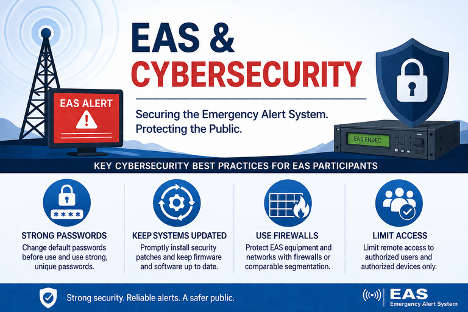
The new requirements would require EAS participants to implement fundamental cybersecurity best practices, including changing default passwords, promptly applying security patches and firmware updates, and protecting EAS-related equipment behind firewalls or comparable network segmentation.
Beyond these immediate requirements, the FCC is seeking comment on several significant proposals that could shape the future of emergency alerting. These include authenticating all EAS alerts before transmission, improving geotargeting accuracy, reducing duplicate alerts through a universal alert identifier, permitting software-based EAS implementations in place of dedicated hardware, and retiring legacy 90-character Wireless Emergency Alert message requirements.
Importantly, the Commission does not propose replacing the current EAS architecture. Instead, it concludes that the existing system remains effective and resilient and should be enhanced through targeted improvements that strengthen security, improve operational efficiency, and leverage modern technologies while maintaining the reliability broadcasters have provided for decades.
Broadcasters should review the proposal carefully, particularly the cybersecurity provisions and the potential transition to software-based EAS solutions, both of which could have operational, technical, and capital planning implications. The proceeding also provides an opportunity for broadcasters to comment on proposed changes before final rules are adopted.
Key Points for Broadcasters
- New cybersecurity requirements for EAS participants:
- Eliminate default passwords and use strong authentication.
- Promptly install software, firmware, and security updates.
- Protect EAS equipment with firewalls or comparable network segmentation. Budget consideration, although firewalls are relatively inexpensive, plan on spending $200-$600 for a simple hardware solution. VPNs and VLANs can quickly increase the cost.
- Response to recent cyber incidents involving unauthorized access to broadcast equipment and false emergency alert transmissions.
- No replacement of the current EAS architecture. The FCC reaffirmed that the legacy EAS network remains a critical and resilient component of the nation’s public warning system.
- Software-based EAS is under consideration, potentially allowing broadcasters to replace dedicated EAS hardware with certified software solutions.
- Alert authentication is proposed to help prevent spoofed or fraudulent emergency messages.
- Improved geotargeting for both EAS and Wireless Emergency Alerts to deliver alerts more accurately to affected areas.
- Universal alert identifiers would reduce duplicate alerts and improve alert management.
- Retirement of legacy 90-character WEA messages would eliminate an outdated requirement tied to older wireless networks.
- Broadcaster participation is encouraged. The FCC is seeking industry input before adopting many of the proposed modernization measures.
This proceeding represents one of the most significant reviews of the Emergency Alert System in recent years and is expected to influence both broadcast operations and emergency communications policy for years to come.