October 26, 2026
by John Baich, SECC Chair & CBA ABIP Inspector
Sangre de Cristo Broadcast Consulting, LLC
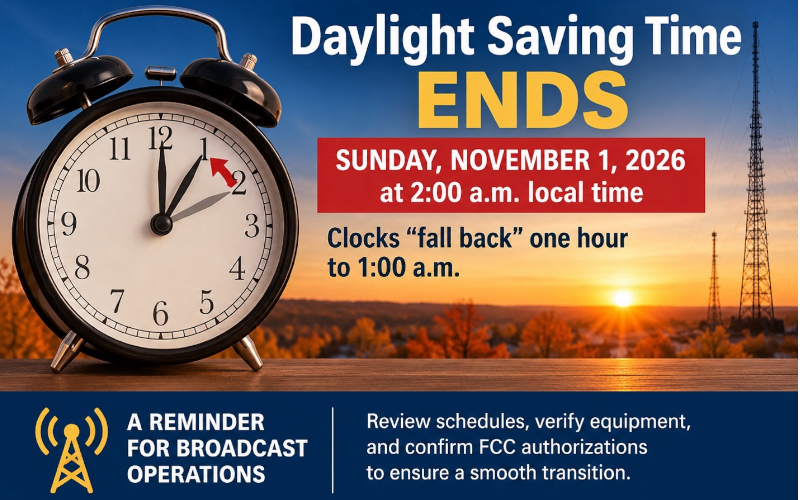
Daylight saving time (DST) ends on Sunday, November 1, 2026, at 2:00 a.m. local time. Clocks will be turned back one hour to 1:00 a.m., marking the return to standard time across most of the United States.
This annual transition requires special attention from broadcasters, particularly AM daytime and directional stations operating under time-restricted authorizations, including pre-sunrise and post-sunset operating authority.
Station engineers should review sign-on and sign-off times, directional pattern changes, and other operating requirements against their current FCC authorizations to ensure continued compliance. Remember that FCC broadcast authorizations specify operating times in standard time.
Pre-Transition Preparations
Engineers and station personnel should take the following steps in advance:
- Update automated program lists to accommodate a 25-hour broadcast day on the transition Saturday/Sunday.
- Confirm that NTP (Network Time Protocol) services are enabled on all workstations, servers, automation systems, and related equipment to maintain accurate synchronization.
Post-Transition Checks
Immediately after the change, perform thorough verifications to catch any disruptions:
- Verify that the EAS (Emergency Alert System) decoder/encoder has correctly adjusted to the new time. Remember the NPT (National Periodic Test) is scheduled for 14:20 EST on Tuesday, November 17, 2026
- Ensure incoming syndicated or network programming feeds remain properly time aligned.
- Review automatic transmitter logging systems to confirm entries reflect the correct times and modes.
- Manually adjust non-NTP-dependent devices, including security systems, wall clocks, and any other analog or standalone timing equipment.
- Document any items that required manual intervention, as facility configurations vary widely, creating a personalized checklist for future transitions is highly recommended.
This seasonal adjustment affects broadcast operations each year, particularly for stations with time-restricted authorizations. Staying proactive helps avoid compliance issues and minimizes on-air disruptions.
Broadcasters are encouraged to review their current FCC authorizations and consult with engineering or legal support as needed ahead of November 1st.